I wish someone had shown me this in first year Uni — they cover everything from staring at a blank page to nailing your final sentence.
In my first year, a lecturer handed back my assignment with the comment that it read like a “hodge-podge of disconnected points.” I had no idea what she meant. I’d worked hard on every sentence. The problem, as I eventually discovered, wasn’t my ideas — it was that I was trying to write in a straight line while my brain was working in a sprawling, branching mess of parallel concepts, memories, vibes, and emotional connections firing all at once. Then I found Arthur Koestler’s brilliant take on the architecture of thought, alongside two classic scientific writing guides from Brown et al. and Gopen and Swan. They completely changed how I organise my thoughts and draft my assignments, and my grades instantly reflected it.
If you master these ideas here is what you’ll walk away with to fix your next paper:
- Why your brain physically cannot think in the linear sequence that writing demands — and what to do instead
- How to use Koestler’s “tree sap” analogy and Brown et al’s “mind-mapping” method to turn vague images into concrete arguments
- Gopen and Swan’s insights about why every sentence has a punchline slot — and how to stop wasting it
Your brain is a parallel processor — your essay is not
Here is the core problem nobody tells you about. Your brain doesn’t generate ideas one at a time in a neat queue. It processes concepts, memories, emotional associations, and half-formed intuitions all simultaneously, in a vast web of connections firing in parallel. Writing, by contrast, is brutally linear — one word, then the next, then the next, in a single grammatical chain. Every time you sit down to write, you are forcing a parallel system to output a sequential one. No wonder it feels like a fight.
The solution is to stop trying to write and think at the same time. Brown and colleagues argue that you must externalise your thinking first, before a single sentence is written — but with one strict rule: never censor what goes into the map, and never force it into order. If you try to arrange your thoughts neatly from the start, you are imposing the linear constraint too early and killing the creative process before it begins. Grab a massive sheet of paper, put your main theme in the middle, and let your thoughts radiate outwards in whatever chaotic direction they want.
Once this chaotic map is filled, Brown et al. argue you must face the most difficult step: distilling your main message. You must look at the sprawl and ask yourself, “if the people who are going to read this paper remember only one point, what would I want that point to be?”. They enforce a strict rule to write this core point directly on your mind-map in 25 words or fewer. This arbitrary limit acts as a ruthless filter for deciding what information to use and what to discard; as the authors note, “like being shot at dawn, it really does focus the mind” and brings the absolute clarity required for successful publishing.
Turn your “airy nothings” into building blocks
There is a profound tension at the heart of scientific writing: the rigid directive to articulate your findings in precise, sequential words directly clashes with the reality of how human thought begins. At this point it can be good to push back on the argument for putting down our ideas into a kind of ‘shopping list’ of words, and that is perfectly described by Arthur Koestler. In his book, The Ghost in the Machine, he points out that before we write, our minds function in non-verbal regions of images and intimations. Ideas exist as feelings, visual impressions, and associations — “airy nothings” — until they crystallise into actual words. This is why staring at a blank page is so painful: you are asking language to appear before the underlying thinking has taken shape. Treat the chaotic nodes on your map as compact building blocks represented by jotted keywords. As you arrange these blocks, transforming thought into language becomes a two-way process that Koestler describes like this:
— Arthur Koestler, The Ghost in the Machine (1967), pp. 55–57
Mind-mapping is a technique, not just a universal and intuitive things all humans can do
The article by Brown et al. actually sets out an almost ‘formal methodology’ for mind-mapping, which is pretty cool. It seems most people I talk to about mind-mapping think it is just a basic kind of activity that everybody must intuitively know how to do, but when I have actually done these mind-mapping activities at workshops I realise many people flail around not really knowing how to start, or what to write down. There is definitely a tendency for them to hold back and try to formulate whole sentences, which as Brown et al. explain can kill the creative process and stifle the actual process of getting the concepts out of your head and onto the paper. You have to practice the art of capturing those ‘airy nothings’ and writing them down. Organising them comes at a later stage, and is also a whole skill in itself that you need to practice.
Here is a diagram that explains the mind-mapping technique visually:
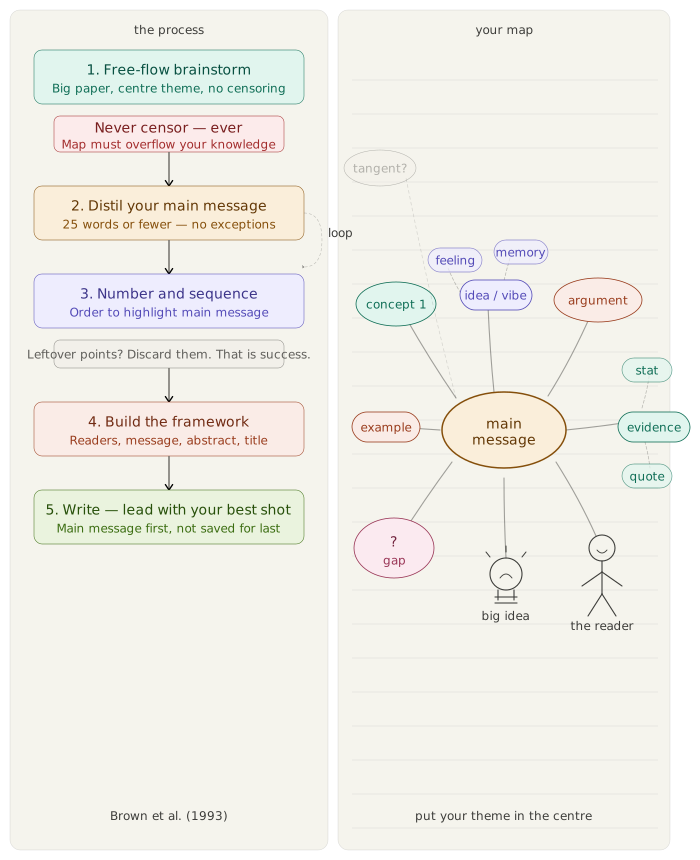
Figure 1: graphical view of the recommended ‘formal mind-mapping’ method
Every sentence is a story with a character, an action, and a punchline
Once you start writing sentences, you need to understand how a reader’s brain actually moves through them. Gopen and Swan argue that readers don’t just passively absorb words — they are constantly making interpretive decisions based on where information appears in a sentence. And those expectations are hardwired and consistent across readers.
Every sentence has a character — the person, thing, or concept whose story it tells. That character belongs at the front, in what Gopen and Swan call the topic position. This is where the reader looks first to understand whose story they are in. Crucially, the topic position should carry old information — something already established in the previous sentence — so the reader feels oriented before they encounter anything new. Think of it as the runway before the landing.
The new, important information belongs at the end — in the stress position. This is the punchline slot. It is where readers naturally exert the most interpretive energy, where emphasis lands, and where they decide what the sentence was actually about.
When you bury your most important idea in the middle of a sentence and trail off with something weak at the end, the reader emphasises the wrong thing. They cannot help it. The stress position fires whether you intended it to or not.
Here are two examples from Duke University’s scientific writing course that show this in action (source):
The topic and main character throughout this paragraph is primate genome sequences. Each sentence keeps that character in the topic position, so the reader always knows whose story they are in:
To understand human evolution, genomes from related primates are necessary. For example, several primate genomes are needed to identify features common to primates or unique to humans. Fortunately, such genome-wide exploration is now a reality. In the past 5 years, genome sequences of several nonhuman primates have been released.
Notice how the subject string reads: genomes from related primates → primate genomes → genome-wide exploration → genome sequences. The topic shifts slightly each time, but it always connects back to the previous sentence's object. The reader can follow the chain effortlessly.
The same paragraph rewritten so the grammatical subjects shift without connecting back:
To understand human evolution, genomes from related primates are necessary. For example, identification of features common among primates or unique to humans will require several primate genomes. Fortunately, scientists can now do such genome-wide exploration. In the past 5 years, the community has released several nonhuman primate genome sequences.
Subject string: genomes → identification of features → scientists → the community. Each sentence introduces a new character with no connection to the last. The reader has to stop and reorient every time — and that cognitive friction is exactly what your lecturer feels when they write "hard to follow."
Sometimes the subject legitimately needs to shift as the argument builds. This is fine — as long as each new subject connects to the previous sentence's object, creating a deliberate relay:
Technology often drives science. Among the most impressive recent technological advances is DNA sequencing. More efficient sequencing has reduced the cost of generating sequence data significantly. Cheaper data in turn enables more researchers to do data-intensive experiments, which results in a huge amount of data being released into the public domain. Dealing with data in such large quantity will require a new generation of scientists.
The subject chain: Technology → DNA sequencing → More efficient sequencing → Cheaper data → Huge amount of data → Dealing with data. Each stressed new idea at the end of one sentence becomes the familiar old idea at the start of the next. This is the old-to-new relay in action — and you can understand the gist of the whole paragraph just by reading the subjects in order.
Chain your stress positions together
Here is where it gets really useful. A single sentence can carry more than one stress position — but only if you create the right structure. A properly used semicolon or colon forces a moment of syntactic closure, which creates a secondary stress position mid-sentence. This lets you land two distinct ideas in a single sentence without the reader losing the thread.
The semicolon tells the reader: “we have arrived somewhere; now here comes the next thing.” Each arrival is a mini-punchline. String several of these together and your paragraphs develop a rhythm that pulls readers forward rather than exhausting them.
Never say at length and imprecisely what you can say exactly with a few words
The legendary journal editor Knut Schmidt-Nielsen understood this instinctively:
"Desert-dwelling mammals (e.g. C. ferus), though well adapted to life in arid environments, nevertheless show signs of distress if deprived of water for long periods."
✅ Schmidt-Nielsen's edit:
"Even camels get thirsty."
The new information — thirsty — lands exactly where the reader expects the punch. Source: Statistical Modeling, Causal Inference, and Social Science (2015)
Stop saving the knockout punch for the end
Once your structure is solid, there is one final trap to avoid. Many writers hold their main argument back from the introduction, saving it for a dramatic conclusion. This is a mistake. Good writing comes quickly and clearly to the point. Put your main message right in the introduction and at the start of your discussion — lead with your best shot, not your warm-up act.
Once you embrace your brain’s messy, non-linear parallel processing and start treating every sentence as a story with a character, an action, and a punchline, your writing stops fighting the reader.
References
Brown, R.F., Pressland, A.J., and Rogers, D.J. (1993). Righting scientific writing: Focus on your main message! Rangeland Journal, 15(2), 183–189. Download PDF
Gopen, G.D. and Swan, J.A. (1990). The science of scientific writing. American Scientist, 78(6), 550–558. Download PDF
Koestler, A. (1967). The Ghost in the Machine. London: Pan Books. (pp. 55–57) Download excerpt
Duke University Scientific Writing Course. Lesson 1: Subjects and actions. Retrieved from https://sites.duke.edu/scientificwriting/lesson-1-subjects-and-actions/